

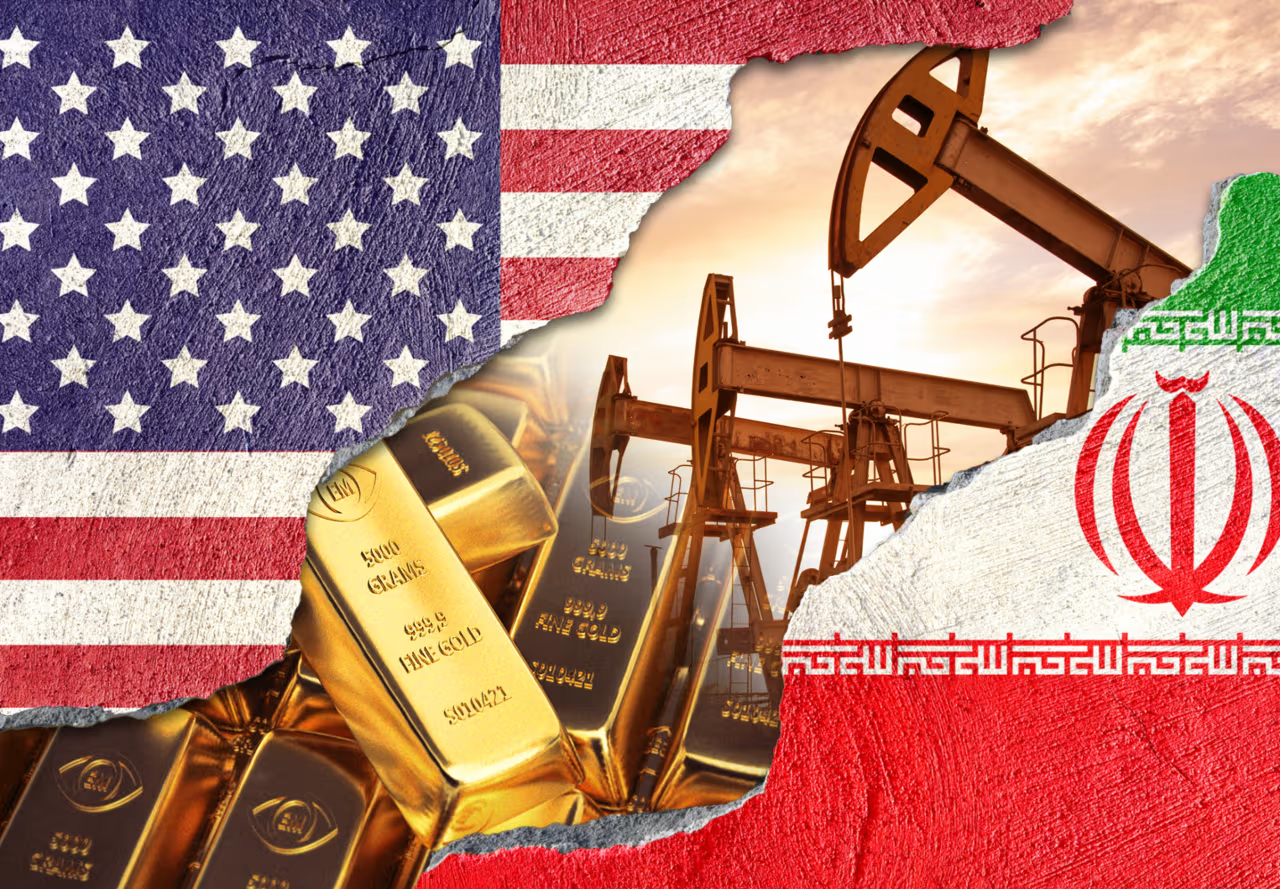

The Iran war impact on U.S. economy is becoming increasingly clear, with rising energy costs leading the pressure while broader economic risks continue to build beneath the surface.
After more than six weeks of conflict, economists say the effects are showing up across inflation, consumer behavior, and financial markets. While the damage is still considered manageable, uncertainty remains the biggest concern.
“There’s going to be some impact on growth, but we’ll weather through it,” said Mike Skordeles, head of U.S. economics at Truist Advisory Services. “The bigger issue is the uncertainty.”
Oil prices remain the key driver
Energy prices are at the center of the Iran war impact on U.S. economy.
Oil has seen sharp swings since the conflict began, briefly climbing above $115 per barrel before settling closer to $90. According to economists, the real economic risk lies ahead if prices rise further.
Joseph Brusuelas, chief economist at RSM, said the tipping point is around $125 per barrel for West Texas Intermediate crude.
“That’s where demand destruction begins to accelerate and broaden out,” he explained.
For now, prices remain below that level. However, continued instability in the Middle East could push oil higher again, increasing pressure on businesses and households.
Inflation shows mixed signals
Inflation is one of the clearest ways the Iran war impact on U.S. economy is being felt.
Recent data shows a mixed picture. Headline inflation rose sharply, with the consumer price index increasing by 0.9% in March. That pushed the annual rate to 3.3%.
However, core inflation, which excludes food and energy, remains more stable. It rose just 0.2% for the month and stands at 2.6% annually.
This suggests that while energy costs are driving price increases, broader inflation pressures are still under control for now.
Still, economists warn that the situation could change quickly if the conflict escalates.
Consumers feel pressure but keep spending
Rising fuel costs are already hitting consumers.
Gas prices recently reached a national average of $4.10 per gallon, adding pressure to household budgets. Higher mortgage rates have also weighed on the housing market, with existing home sales falling to a nine-month low.
Despite this, spending remains surprisingly strong.
Data from Bank of America showed debit and credit card spending rose 4.3% in March. Spending at gas stations jumped 16.5%, but non-gas spending also grew by 3.6%.
This suggests consumers are still holding up, even as costs rise.
David Kelly, chief global strategist at JPMorgan Asset Management, noted that sentiment does not always match behavior.
“A fall in consumer sentiment has never been a reliable predictor of actual consumer behavior,” he said.
Consumer sentiment drops to record lows
While spending remains resilient, confidence has taken a hit.
The widely followed University of Michigan survey shows consumer sentiment has fallen to its lowest level on record, dating back to the 1950s.
This reflects growing concerns about inflation, interest rates, and the broader economic outlook.
However, economists caution that weak sentiment does not always lead to reduced spending. Many consumers continue to spend even when they feel pessimistic about the economy.
Federal Reserve faces a difficult path
The Iran war impact on U.S. economy is also shaping expectations for the Federal Reserve.
Before the conflict, markets expected the Fed to continue cutting interest rates to support growth. Now, rising inflation and uncertainty have complicated that outlook.
Economists say the central bank is likely to remain cautious in the near term.
“The spike in oil prices and increased uncertainty have kept the Fed firmly in wait-and-see mode,” analysts at Goldman Sachs said.
Goldman Sachs expects the Fed could still cut rates later in the year, possibly in September and December. However, that will depend on how inflation and growth evolve.
Growth outlook weakens but avoids major damage
Despite rising risks, most economists believe the overall impact on growth will be limited.

Estimates suggest the war could reduce U.S. GDP growth by a few tenths of a percentage point rather than triggering a major downturn.
Goldman Sachs recently cut its growth forecast for the year to 2%, down by half a percentage point. Meanwhile, the Atlanta Fed projects first-quarter growth at 1.3%.
The labor market may also weaken slightly. Goldman now expects unemployment to rise to 4.6% by the end of the year.
These changes reflect a slowdown, but not a collapse.
Global ripple effects add to uncertainty
The Iran war impact on U.S. economy is closely tied to global developments.
Energy markets are interconnected, and disruptions in the Middle East affect economies worldwide. Europe and Asia, which rely more heavily on imported energy, could face greater pressure.
“We’re feeling a price shock because of energy, but not really a supply shock,” Skordeles said. “Asia is the one getting clobbered.”
Supply chains are also starting to feel the strain. The New York Fed’s Global Supply Chain Pressure Index has risen to its highest level since early 2023.
If disruptions continue, these pressures could spread further into the U.S. economy.
Outlook depends on how the conflict evolves
Looking ahead, much depends on whether the current ceasefire holds.
If tensions ease, inflation pressures could fade, allowing the economy to stabilize. However, if fighting resumes, the outlook becomes far more uncertain.
Higher oil prices, persistent inflation, and delayed rate cuts could combine to slow growth more significantly.
For now, economists remain cautiously optimistic.
“Energy costs have increased, but they’re still lower than in past decades,” Skordeles said. “We’ll suffer through it. It’s not game over.”