
Global financial markets are once again under pressure as renewed hostilities between the United States and Iran shake investor confidence and raise fresh concerns about the stability of energy supplies.
After days of cautious optimism around a potential peace deal, escalating military actions and rising geopolitical tensions have shifted sentiment. Analysts now warn that markets may be entering a more volatile phase as the conflict intensifies.
Escalation Shakes Fragile Market Optimism
Over the past 48 hours, tensions between the U.S. and Iran have ramped up significantly. Hopes that a fragile ceasefire could evolve into a longer-term agreement have been undermined by fresh attacks and aggressive rhetoric.
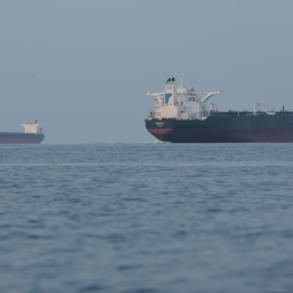
The situation has become particularly sensitive around the Strait of Hormuz, a critical global shipping route that remains largely blocked.
Market participants had been betting on a gradual de-escalation. However, recent developments suggest the conflict could be entering a new and more unpredictable phase.
Ben Powell, chief investment strategist for APAC at BlackRock, described the current moment as highly uncertain.
“It’s an incredibly delicate moment,” Powell said, noting rising tensions in the region.
He added that missile warnings in Abu Dhabi — after a period of relative calm — have heightened concerns among investors and residents alike.
Strait of Hormuz Remains a Critical Pressure Point
At the center of the crisis is the ongoing disruption in the Strait of Hormuz, through which a significant portion of the world’s oil and gas supply typically flows.
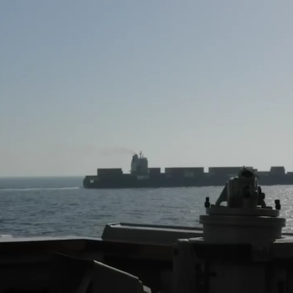
The U.S. recently launched a strategy dubbed “Project Freedom,” aimed at reopening the waterway by escorting stranded commercial vessels safely out of the region.
However, the effort was met with resistance from Iran.
According to U.S. officials, several Iranian boats were sunk during skirmishes in the channel. Iran, however, denied that any of its vessels were destroyed.
The standoff has kept shipping activity severely limited, contributing to tightening energy supplies and increased market volatility.
Renewed Attacks Add to Market Anxiety
The situation escalated further after Iran launched missile and drone attacks on oil infrastructure in the United Arab Emirates.
These strikes are seen as part of a broader strategy to exert pressure on regional allies and influence negotiations with the United States.
Powell noted that energy and other key components of the global economy are no longer flowing as expected.
He warned that the market may be approaching a “critical moment” as inventories decline and the delayed effects of the energy shock become more visible.
Markets React With Volatility
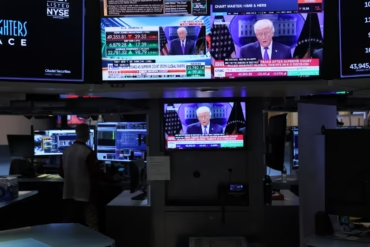
Financial markets reflected the growing uncertainty.
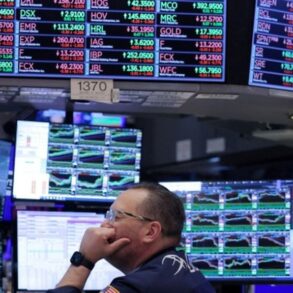
Asian markets moved lower, European markets were mixed, and U.S. stock futures showed signs of recovery after earlier losses.
The uneven performance highlights the fragile balance between optimism and risk.
Earlier declines in major U.S. indexes, combined with rising oil prices, underscore how sensitive markets have become to geopolitical developments.
Analysts Warn of a Turning Point
Experts believe the latest escalation could mark an inflection point in the conflict.
Tina Fordham, founder of Fordham Global Foresight, warned that markets are at a crossroads.
“The question of the week is whether geopolitical risks will remain messy but contained, or break through to weigh on markets and corporate earnings,” she said.
Fordham indicated that recent attacks suggest the situation may be moving toward greater instability.
She described the renewed strikes as “the biggest escalation in some weeks,” signaling that Iran retains significant capacity to respond militarily.
Ceasefire Under Increasing Pressure
The fragile ceasefire between the U.S. and Iran now appears increasingly at risk.
Geopolitical analysts warn that a complete collapse of the agreement is becoming more likely as both sides escalate their actions.
Fordham emphasized that Iran is demonstrating it still has leverage in the conflict.
“Iran is signalling that they still have the capacity to inflict pain and won’t be forced into capitulation,” she said.
She added that the United States faces a difficult choice between prolonging the conflict or accepting a less favorable deal.
‘Project Freedom’ Meets ‘Project Deadlock’
The latest tensions appear closely linked to the U.S. initiative known as “Project Freedom.”
The strategy was designed to break the deadlock over the Strait of Hormuz and restore shipping activity.
However, Iran has criticized the plan, referring to it as “Project Deadlock.”
Abbas Araghchi, Iran’s foreign minister, indicated that the approach could worsen the situation rather than resolve it.
He warned that the latest developments highlight the limits of military solutions.
“There’s no military solution to a political crisis,” Araghchi said.

Diplomatic Efforts Continue Amid Rising Tensions
Despite the escalation, diplomatic efforts are still ongoing.
Pakistan has been mediating talks between the United States and Iran, although progress has stalled in recent weeks.
Both sides remain divided over key issues, including control of the Strait of Hormuz and broader regional dynamics.
Araghchi signaled that Iran remains open to negotiations, stressing the importance of a political solution.
He also cautioned that external actions could derail ongoing efforts.
Energy Supply Concerns Intensify
The continued disruption of the Strait of Hormuz is raising serious concerns about global energy supplies.
With limited shipping activity, oil and gas flows have slowed significantly, tightening markets and pushing prices higher.
This has broader implications for inflation, economic growth, and global trade.
As inventories decline, the risk of supply shortages becomes more pronounced.
A Critical Moment for Global Markets
Market analysts agree that the coming days will be crucial.
Investors are closely watching whether tensions escalate further or if diplomatic efforts can stabilize the situation.
Powell highlighted the complexity of interpreting recent events.
He suggested that the escalation could either be part of negotiation tactics or the beginning of a more prolonged conflict.
This uncertainty is contributing to heightened volatility across financial markets.
Outlook Remains Highly Uncertain
The current environment is defined by uncertainty.
Markets are reacting not only to actual developments but also to shifting expectations about the future of the conflict.
With the Strait of Hormuz still largely closed and military actions increasing, risks to the global economy remain elevated.
Analysts warn that unless a clear path to de-escalation emerges, markets are likely to remain on edge.