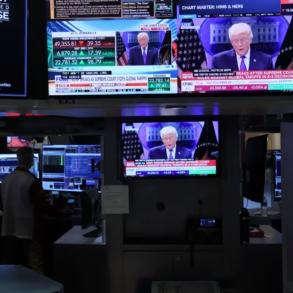


U.S. President, Donald Trump renewed threats against Iran’s energy infrastructure as oil prices climbed sharply, with the conflict now entering its fifth week and raising concerns about further supply disruptions.
Oil prices held near session highs on Monday morning as two key developments — one from the Gulf and another from Washington — stoked fears that the war could escalate and further tighten global supply.
Futures on Brent crude, the international benchmark, traded around $108 per barrel, up roughly 3% on the session, while U.S. West Texas Intermediate crude rose to about $102 per barrel.
Oil prices and supply disruptions
Two major developments have dominated the oil market since trading opened.
The first centers on rising threats around critical shipping routes. The entrance of the Houthis, an Iran-backed militia based in Yemen, has heightened risks in the Bab el-Mandeb Strait — a key chokepoint linking the Red Sea to global markets.
With the Strait of Hormuz effectively closed, Saudi Arabia’s East-West Pipeline has become a crucial alternative route for crude exports. That pipeline, which runs to the Red Sea, is already operating at full capacity of about 7 million barrels per day, leaving little room to offset further disruptions.
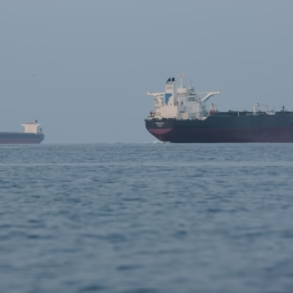
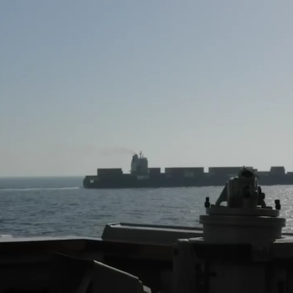
To move through the Red Sea, tankers must pass the Bab el-Mandeb Strait, which remains within striking distance of Houthi forces. Insurance costs for these routes have surged, and some shipowners are already avoiding the passage.
Analysts warn that if the strait were to be blocked, the global market could lose another 7 million barrels per day of supply, adding to an estimated 15 million barrels per day already at risk.
Capital.com senior analyst Kyle Rodda described the situation as a growing threat, noting that the militia effectively has “its proverbial gun pointed at the Bab el-Mandeb — the ‘Gate of Tears.’”
Trump escalates pressure on Iran
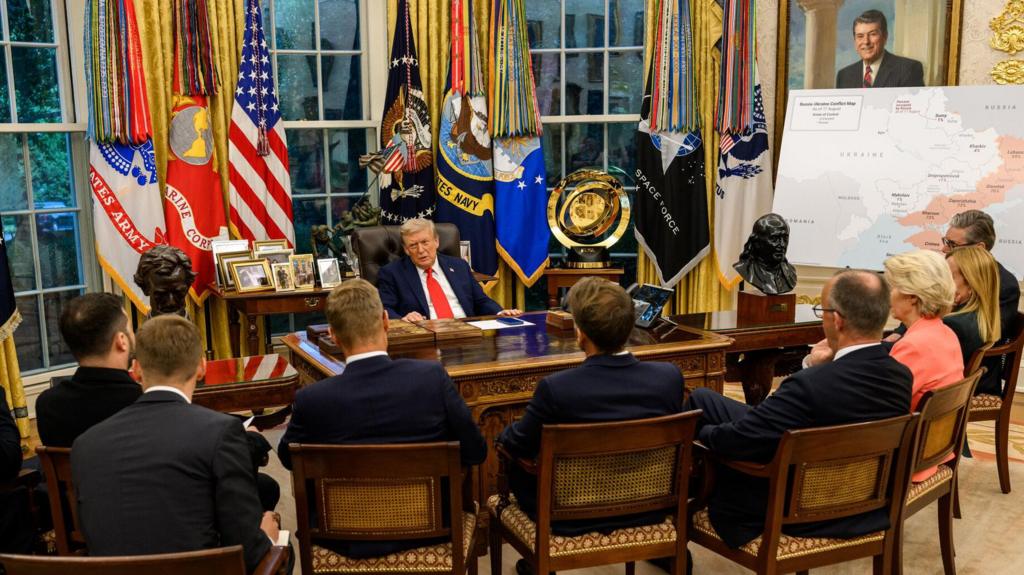
The second major driver of oil price gains came from Washington, where Trump intensified his rhetoric and signaled potential military escalation.
In a Truth Social post, Trump said the U.S. is “in serious discussions with A NEW, AND MORE REASONABLE, REGIME to end our Military Operations in Iran” and added that “great progress has been made.”
However, he warned that if a deal is not reached and the Strait of Hormuz is not reopened, the U.S. would take aggressive action.
Trump said the U.S. would “blow up and completely obliterating all of their Electric Generating Plants, Oil Wells and Kharg Island (and possibly all desalinization plants!), which we have purposefully not yet ‘touched.’”
Separately, he warned Iran to immediately reopen the strategically vital Strait of Hormuz or risk attacks on its oil wells and power plants.
Kharg Island, a major fuel hub that handles roughly 90% of Iran’s crude exports, has become a focal point in the conflict. The facility has a loading capacity of about 7 million barrels per day, making it central to global oil flows.
Shipping traffic through the Strait of Hormuz has largely ground to a halt since the conflict escalated, with Iran targeting vessels attempting to pass through the corridor.
Market reaction and military buildup
Despite the surge in oil prices, markets have remained volatile, reacting quickly to shifts in geopolitical signals.
Futures initially climbed on supply concerns but later pared gains after Treasury Secretary Scott Bessent suggested the possibility of restoring safe passage through the region.

Bessent said the U.S. could ensure “freedom of navigation — whether it is through US escorts or a multinational escort,” pointing to potential efforts to stabilize shipping routes.
Meanwhile, the U.S. has significantly increased its military presence in the Gulf. Reports indicate that troop levels have risen to around 50,000, including rapid-response forces such as the Army’s 82nd Airborne Division.
Additional reports suggest the administration is considering more aggressive options, including deploying special operations forces to secure critical assets.
Analysts warn that such moves could trigger immediate retaliation and further disrupt global energy markets.
JPMorgan strategists noted that as the conflict expands — particularly with the possibility of attacks on infrastructure or a broader regional involvement — the risk of escalation continues to rise.
“Increasingly, the issue is becoming less a question of if than of when,” they said.
Outlook as war enters fifth week
As the war enters its fifth week, oil markets remain highly sensitive to both military developments and political signals.
The combination of constrained supply routes, rising geopolitical risks, and direct threats to key energy infrastructure has kept prices elevated and volatility high.
With key chokepoints under pressure and negotiations still uncertain, the outlook for oil markets will likely depend on whether tensions ease — or escalate further in the days ahead.