

President Donald Trump will need to rely on alternative legal pathways if he intends to reconstruct his tariff framework after the US Supreme Court ruled that he overstepped his authority by invoking a 1977 emergency statute to impose broad import taxes.
In its decision, the court determined that Trump improperly used the International Emergency Economic Powers Act to justify sweeping “reciprocal” tariffs directed at major US trading partners, along with separate duties targeting China, Canada, and Mexico.
WATCH: The US Supreme Court struck down President Donald Trump’s global tariffs, concluding that he exceeded executive authority. Bloomberg’s Nathan Dean and Mike McKee analyze potential next steps for the administration.
The ruling nullifies a substantial share of the tariffs introduced during Trump’s second term. However, it does not eliminate the president’s ability to levy import taxes altogether. Although the Constitution assigns Congress the authority to impose taxes and duties, lawmakers have delegated certain tariff powers to the executive branch through various statutes.
What Alternatives Does Trump Have Beyond IEEPA?
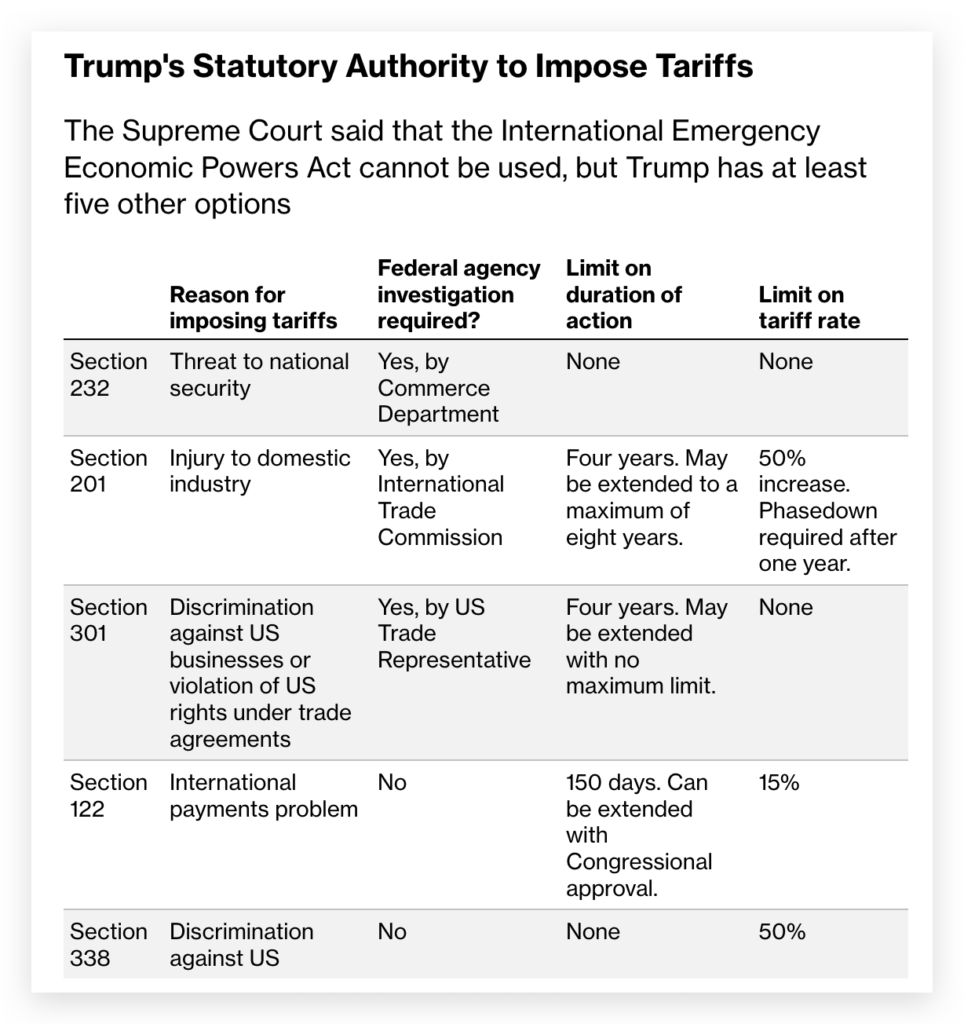
The president retains at least five statutory mechanisms that could serve as fallback options. These alternatives, however, generally involve stricter procedural requirements and clearer limitations, reducing the executive branch’s ability to act swiftly or set tariff rates without constraint.
Trump’s Statutory Authority to Impose Tariffs
While the Supreme Court blocked the use of the International Emergency Economic Powers Act, other provisions remain available:
- Section 232
Basis: National security threat
Investigation Required: Yes, by the Commerce Department
Duration Limit: None
Rate Limit: None - Section 201
Basis: Injury to domestic industry
Investigation Required: Yes, by the International Trade Commission
Duration Limit: Four years, extendable to eight
Rate Limit: Up to a 50 percent increase, with phased reductions after one year - Section 301
Basis: Discriminatory trade practices or violations of US trade rights
Investigation Required: Yes, by the US Trade Representative
Duration Limit: Four years, extendable without a maximum cap
Rate Limit: None - Section 122
Basis: International payments imbalance
Investigation Required: No
Duration Limit: 150 days, extendable with Congressional approval
Rate Limit: 15 percent - Section 338
Basis: Discrimination against US commerce
Investigation Required: No
Duration Limit: None
Rate Limit: 50 percent
Source: Congressional Research Service, Bloomberg
Section 232 of the Trade Expansion Act of 1962
Authority Granted:
Section 232 authorizes the president to impose tariffs on national security grounds. There is no statutory cap on either the level of duties or their duration.
Constraints:
Tariffs cannot be imposed immediately. The Commerce Department must first conduct an investigation and determine that imports threaten national security. The Commerce Secretary has 270 days to report findings once a probe begins.
Unlike the broad countrywide tariffs attempted under IEEPA, Section 232 applies to specific sectors rather than entire nations.
Historical Use:
Trump relied on Section 232 in 2018 to impose tariffs on steel and aluminum imports. During his second term, he revived and expanded these measures, including 50 percent duties tied to prior investigations. He also targeted automobiles and auto parts based on a 2019 probe. Additional products such as semi-finished and derivative copper goods have been subjected to similar measures, with further investigations currently underway.
Section 201 of the Trade Act of 1974
Authority Granted:
Section 201 allows tariffs when rising imports cause or threaten serious injury to domestic producers.
Constraints:
The International Trade Commission must investigate and submit a report within 180 days of a petition. Public hearings and comment periods are mandatory.
Tariffs under this section are industry-specific, capped at 50 percent above existing duties, and limited to four years, extendable to eight. If maintained beyond one year, they must be gradually reduced.
Historical Use:
In 2018, Trump imposed Section 201 tariffs on solar panels and residential washing machines. The solar measures were later adjusted by President Joe Biden, while washing machine duties expired in 2023.
Section 301 of the Trade Act of 1974
Authority Granted:
Section 301 empowers the US Trade Representative, under presidential direction, to levy tariffs against countries engaged in discriminatory trade practices or violations of trade agreements. No cap exists on tariff levels.
Constraints:
An investigation is required, including consultations with the foreign government involved and opportunities for public comment.
Tariffs automatically expire after four years unless continuation is requested. While typically country-specific, parallel investigations can address shared practices across multiple jurisdictions.
Historical Use:
The first Trump administration used Section 301 to impose tariffs on hundreds of billions of dollars in Chinese goods following an investigation into technology transfer and intellectual property practices. President Biden later increased certain Section 301 tariffs, including those on electric vehicles.
In July 2025, the US Trade Representative launched a Section 301 investigation into Brazil’s trade policies, intellectual property framework, deforestation concerns, and ethanol market access.
Section 122 of the Trade Act of 1974
Authority Granted:
Section 122 permits the president to impose temporary tariffs to address serious balance of payments issues without waiting for an agency investigation.
Constraints:
It may be invoked only to correct significant trade deficits, broader international payments imbalances, or prevent a sharp dollar depreciation.
Tariffs are limited to 15 percent and can remain in effect for only 150 days unless Congress approves an extension.
Historical Use:
Section 122 has never been used. In earlier litigation over Trump’s IEEPA tariffs, the US Court of International Trade noted that efforts to address trade deficits would properly fall under Section 122 rather than emergency powers legislation.
Section 338 of the Smoot Hawley Tariff Act of 1930
Authority Granted:
This Depression-era statute allows the president to impose tariffs when foreign nations are found to discriminate against US commerce or impose unreasonable trade barriers.
No formal investigation is required before action is taken.
Constraints:
Tariffs are capped at 50 percent.
Historical Use:
Section 338 has never been invoked. Any attempt to use it would likely face immediate legal scrutiny. Its potential revival has raised concerns among some lawmakers. In March 2025, five House Democrats introduced legislation seeking to repeal this provision.
The Reference Shelf
Bloomberg Economics outlines the broader implications of the Supreme Court’s ruling.
Bloomberg’s Big Take examines lawsuits filed by more than 1,000 companies challenging the administration’s tariff policies.
The Congressional Research Service released an April report reviewing the respective authorities of Congress and the president in imposing import tariffs.